1. If the goal is headcount savings, what should you look at first?
One area Company P was interested in was applying agents to the operational work people do today, to cut repetitive tasks and raise operational productivity.
It is the effect companies most often expect from agents.
But rather than replacing whole jobs with a single agent, the first move is to break the current work into steps and separate what AI does well from what needs human judgement.
For commerce and marketing operations, the steps might break down like this:
Collect data → analyse → detect anomalies → write the report → propose a response → decide and act
Among these, structured data handling and repetitive analysis and reporting are where agents apply most readily.
The question that actually came up was whether AI can analyse incoming data and produce the report.
What matters one step beyond that is not only generating a report in an existing format.
An agent can analyse the same data from angles the existing format does not cover, and follow the user's further questions into new views of that data.
So the value of an agent goes past report automation into how much repetitive human work it removes along the path of
Data → Analysis → Insight → Action.
2. Internal AI and customer-facing AI are hard to design to the same standard
One of the more interesting questions was whether an agent could serve not just employees but customers directly.
Technically, yes.
But customer-facing AI raises problems an internal work assistant does not.
With an internal agent you can predict the users, the purpose, and the scope of work reasonably well. With customer-facing AI used by an open population, you cannot know in advance what will be asked, how often, or how far people will push it.
That turns directly into a cost and quality-management problem.
Usage growth raises LLM API and infrastructure cost, and you have to decide what standard response quality will be judged against.
So designing customer-facing AI means weighing at least three things alongside the feature itself:
scope control / cost management / response-quality evaluation
The important question in enterprise AI does not stop at "can AI do this?" — it has to carry through to "can we operate it?"
3. For AI to understand your data, start with the data structure
Another substantial thread was how far AI can understand and structure product information.
Commerce data is not always tidy.
Product names vary, attribute schemes are not unified, and the same product is often managed in different shapes across several systems.
AI can help interpret that unstructured information and organise it into a consistent structure.
But AI being able to read the data and the company being able to use that data under one consistent meaning system are different problems.
This is where ontology and knowledge structure matter.
For a company with existing systems, the data already in place needs to go through
cleaning → analysing the existing schema → defining semantic relations → schema mapping → building the knowledge structure
So the more legacy there is, the more effort goes into converting existing data into a knowledge structure AI can use rather than into the model itself.
Building a new system changes the picture.
Because the knowledge structure AI will later use can be considered from the initial data-modelling stage, data consistency is comparatively easier to secure than converting an existing system after the fact.
That carries a useful implication for companies preparing AI systems.
Being AI-ready does not start with adopting a model. It can start at the stage where the data structure is designed.
4. As agents multiply, managing them matters more than building them
The meeting spent as much time on governance and operations as on agent capability.
Can agents be monitored?
Can the deployment process be managed?
Can you control which agents are running?
At the PoC stage, what matters is whether one agent produces the answer you wanted.
Once a company has 10, 50, or 100 agents, the nature of the problem changes.
Who built the agent, which model and data it uses, who approved deployment to production, and — when something goes wrong — which agent's execution it came from all have to be traceable.
So an enterprise AI platform needs, alongside the build capability,
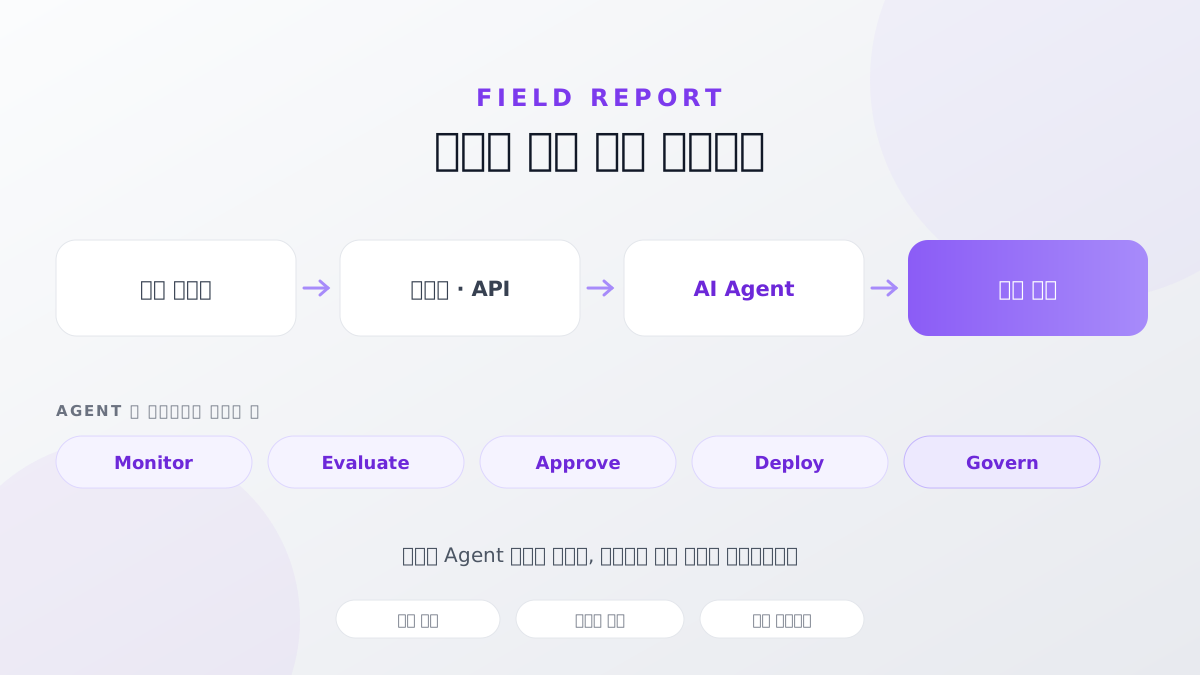
Monitor → Evaluate → Approve → Deploy → Govern
as an operating system around it.
Once agents connect to real enterprise systems and start carrying out work, these management capabilities matter still more.
5. How you connect existing systems to AI matters too
Enterprise AI adoption rarely targets new systems alone.
Back office, commerce platform, marketing systems, product data, customer data — they are already running.
So the practical task in enterprise AI is often less about building a separate AI service and more about how to connect AI to the work systems already in place.
This discussion covered whether existing operational systems could be connected to XGEN for agents to work through, and whether API and MCP integration is supported.
An agent in an enterprise setting is therefore likely to develop as
existing systems → data and APIs → AI agent → work carried out
rather than as something standalone.
Which is why choosing an AI platform means looking at integration structure and extensibility alongside model performance.
Four things this discussion left us with
The meeting was not about fixing the scope of a project. It was about exploring how agents might be used across consulting and commerce operations.
Along the way, four questions surfaced that most companies weighing enterprise AI will need to answer.
① Which work will AI take over?
Not "replace people with AI," but break the current work into steps and start where AI can act repeatedly.
② Who is the AI for?
Internal use and customer-facing service need different operating strategies for usage, cost, and quality.
③ Is the data AI will use ready?
In a legacy environment, cleaning, schema mapping, and knowledge structuring can be a bigger task than the model.
④ How will the agents be operated?
As agents multiply, monitoring, evaluation, deployment, permissions, and governance need to be handled at the platform level.
Field Report
Discussions about enterprise AI usually open on "which model" and "which agent to build."
The questions from a real enterprise setting shift quickly.
Which of our existing work goes to AI.
Whether AI can properly understand our data.
How it connects to the systems we already run.
How usage and quality get managed.
And who controls a large number of agents, and how.
The competitive edge in enterprise AI does not end with building one excellent agent.
When data, existing systems, agents, and operations and governance can be connected inside one working system, AI moves past the demo and into how the company actually operates.