

Running a blog and building the structure a blog runs on are different things
Run a corporate engineering blog long enough and you meet the same problem.
Developers want to write, but the maintainer cannot hand out repository access lightly. And the alternative — the maintainer taking drafts and committing on their behalf — does not last. As posts accumulate the maintainer becomes the bottleneck, and it gets steadily harder for developers to publish.
In the end the question was not "who writes" but "how easy is it to contribute."
Keep the permissions, lower only the cost of participation
What we chose this time is Decap CMS's Open Authoring.
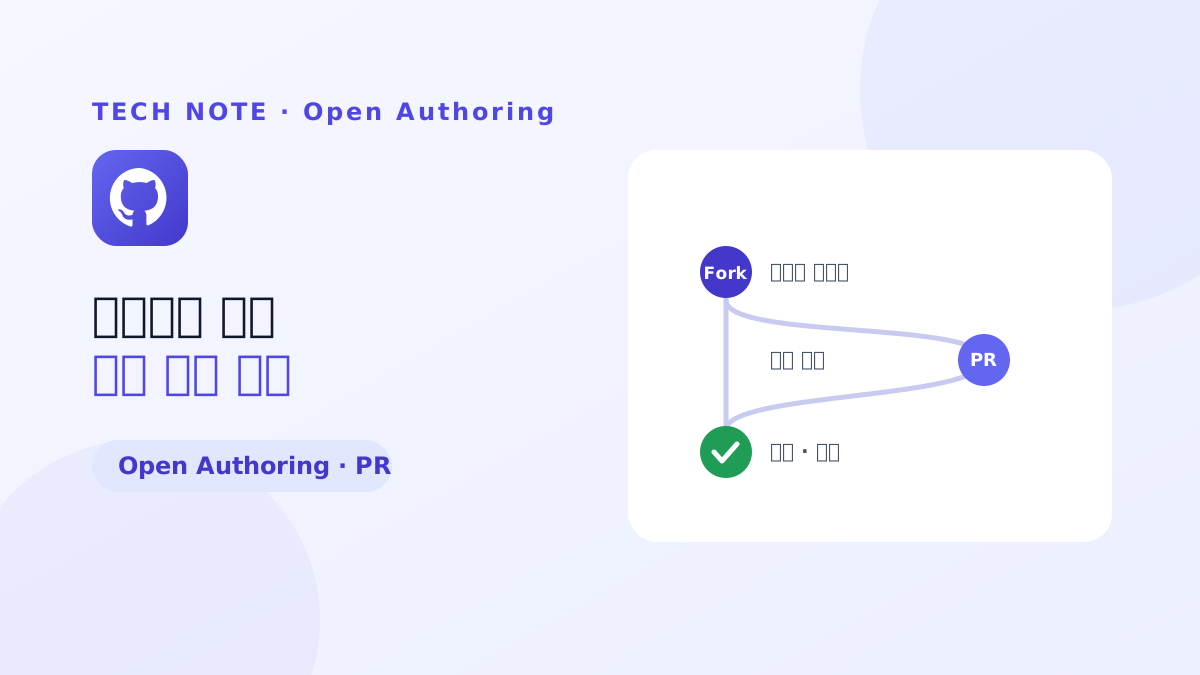
Open Authoring grants no additional access to the main repository. An author logs in with their own GitHub account, writes in their personal fork, and the system automatically opens a pull request against the original repository.
The maintainer reviews and merges the PR, exactly as before.
The way we operate stays the same, while contributors can publish without a separate access request.
Technically it is a simple feature. From an operations point of view it is a structure that secures permission management and content productivity at the same time.
Leaving the author as a person, not a system
For an engineering blog, trust matters more than information.
Even with the same content, knowing who wrote it carries the context and the expertise along with it.
So every post also carries authorGithub.
Where that value exists, the view automatically links the GitHub profile and avatar, and search engines and AI services receive it as Person metadata.
That makes a post not just a Markdown document but a knowledge asset managed together with its author.
More important than the technology is the operating structure
The purpose of this work was not to adopt a CMS.
The real purpose was to build a structure where content accumulates naturally without the maintainer having to step in.
An individual writes, the team reviews, deployment is automated, and the system manages the author's record.
The maintainer stops being the person who registers content on someone's behalf, and can focus on raising quality together.
What is left in the end is culture
Technology only lowers the barrier to participation.
A blog where posts keep accumulating is not made by a system alone.
A culture has to settle in alongside it — collecting ideas so good ones do not disappear, treating review as a process of raising quality together rather than an approval gate, and letting authors leave a record under their own name.
Applying Open Authoring was less a case of bolting on a new feature than the first step in designing an operating structure where a corporate engineering blog accumulates individual records as organizational knowledge.