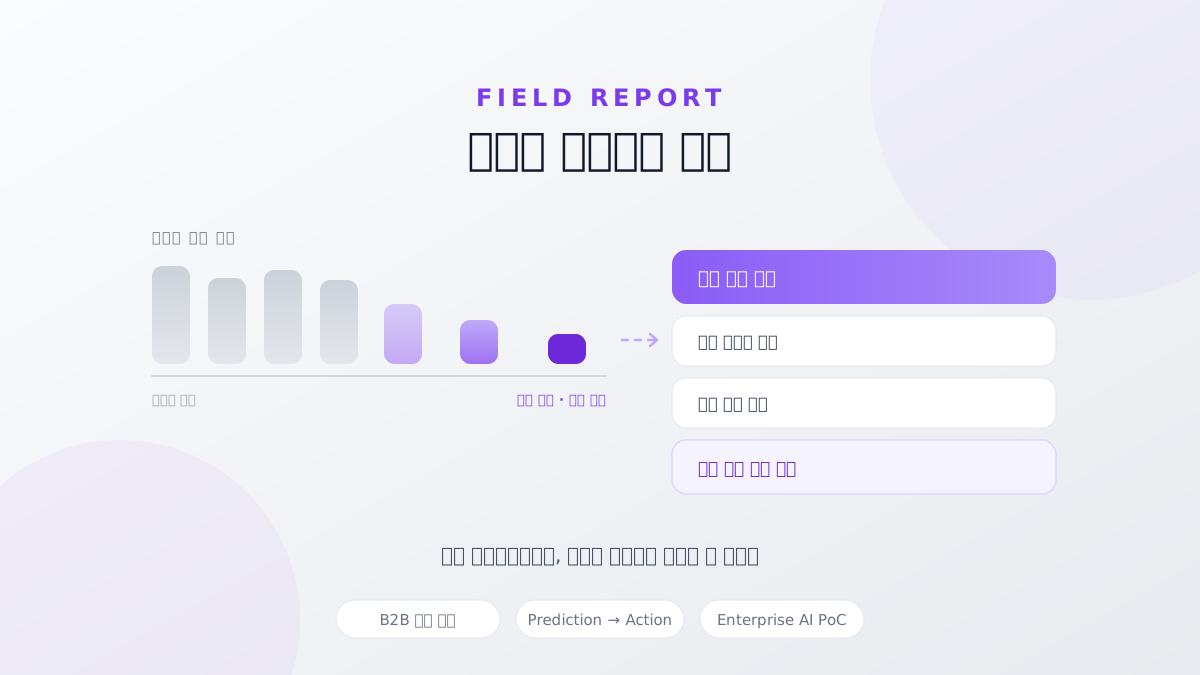
First question: what counts as a churn signal in B2B?
In B2C, changes in customer behaviour show up in many forms.
Whether purchase frequency has dropped, whether basket size has fallen, what products were browsed, what went into the cart — a range of behavioural data can be used to estimate interest and the likelihood of churn.
B2B food distribution behaves differently.
At Company D, the items each account buys are largely fixed, and a steady purchasing pattern repeats. That is some distance from the browsing-comparing-buying behaviour of a consumer.
So in B2B churn prediction, catching anomalous change in an established trading pattern may matter more than customer-propensity analysis.
Changes such as these:
- Has the ordering cycle stretched out?
- Are orders for a specific core item falling steadily?
- Has the average order value been declining over a period?
- Has a previously stable pattern shifted abruptly?
- Has trade failed to recover even after sales activity?
What matters in the end is less "what kind of customer is this?" and more "compared with this account's usual pattern, what has changed?"
Prediction alone is hard to use on the ground
The other thing we weighed was whether showing a churn probability is enough on its own.
Suppose a dashboard reads:
Account A — churn risk 82%
Even if the prediction is accurate, it does not connect directly to what the sales rep does next.
What the business wants is one step further on:
Why was this judged a risk, and what should be done now?
So AI that genuinely supports sales needs to run along this line:
Analyse trading data → detect anomalous patterns → judge churn likelihood → give the reasoning → recommend a sales response
For example: reasoning along the lines of "over the past three months orders for core items have fallen steadily and the average ordering cycle has lengthened," paired with a direction such as "have the rep check in with the account and propose items likely to be reordered."
At that point the AI moves past being a prediction model and extends into a sales agent that supports the rep's judgement and action.
Before the AI comes "how our company sells"
Data and models are what usually get discussed first when a PoC starts.
Something else came first here.
Namely, the judgement criteria and guidance the business already uses in the field.
Which changes count as a churn signal, which accounts get priority, what a rep does when a risk signal appears — those working rules have to be written down before AI can produce judgements and strategies that fit how the company works.
In other words:
the company's sales know-how + trading data + AI
have to come together.
This is why structuring a company's working know-how matters so much in an AI rollout.
The shorter the PoC, the sharper the question has to be
We discussed compressing the PoC to something verifiable within days.
Trying to build a full production-grade system in a short PoC spreads the time across data cleaning, UI work, and system integration — and the thing that actually needed proving, whether AI applies at all, ends up untested.
So an early PoC does better to concentrate on these questions:
First, can meaningful churn signals be found in the existing trading data?
Second, can the AI explain the basis for that judgement in a form the business understands?
Third, can it propose a usable response that reflects the company's own sales criteria?
Once those three are settled, extending step by step into system integration, mobile, dashboards, and user permissions is the realistic path.
How do automation tools like n8n differ from agentic AI?
Workflow automation tools and AI agents often come up together in enterprise AX discussions.
This is less a matter of choosing one than of separating roles.
Workflow automation, which passes data and calls systems according to set conditions, and an AI agent, which interprets data to judge a situation and propose a fitting response, solve different kinds of problem.
For instance,
"send the rep an alert when order volume falls below a threshold" sits close to automation.
Whereas
"analyse recent trading patterns to judge churn likelihood, and propose the reason along with an appropriate sales response" puts the weight on the agent.
In a real enterprise setting, the design that matters is connecting what automation does well with what AI has to judge — rather than treating the two as rivals.
Three things this PoC discussion left us with
What this session confirmed again is that an AI project does not have to start from AI technology.
① Churn in B2B has to be defined differently from B2C.
Repeat purchasing patterns per account, and shifts in those patterns, can be a stronger signal than browsing and clicks.
② Action matters more than prediction.
It cannot stop at "who will churn." It has to carry through to "why was it judged that way, and what should the rep do" before the business can use it.
③ A PoC is about the hypothesis to test, not the number of features.
Rather than building dashboards and screens first, establish whether meaningful signals exist in the real data and whether they can be combined with the company's working criteria.
Field Report
The value of enterprise AI is not decided by the model itself.
Especially in an area like B2B sales, where every company manages customers and trade differently, what counts is how well the field's judgement criteria are structured, connected to real data, and turned back into work that can actually be carried out.
Which is why the first question of a good AI PoC is closer to "what signals does the business watch, and how does it judge them?" than to "which AI should we use?"
Plateer AI Labs takes questions like these from the field, tests them against real data in short verification cycles, and works toward the form of agentic AI that fits the work a company actually does.