


The Challenge
Why does Enterprise AI stall in the field?
Adopted AI, but it stalled at the pilot?
A great many AI projects finish at technical validation and never reach the actual work.
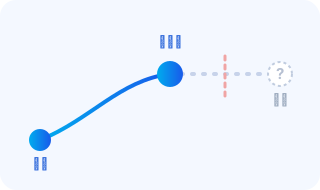
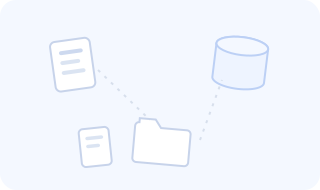
Data and systems scattered?
Documents, knowledge, and legacy sit apart, so the AI never grasps the organization's context.
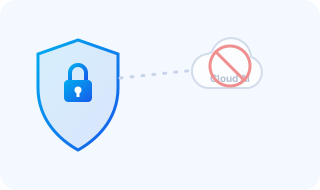
Security and regulation ruling out cloud AI?
Data sovereignty, audit, and approval requirements make external AI hard to adopt.
XGEN · Agentic AI Platform
XGEN is different
It doesn't stop at the pilot — the proof is in numbers validated in real on-premise operation.
100%
On-premise operation
Network separation · data sovereignty
80+
Built-in tools and plugins
Extensible with your own
Grade 1
National GS certification
Verified by third-party testing
18
Open-source libraries
MIT · install with pip
4 Core Values
The core values enterprise AI operation rests on
Building the AI is not where it ends. Connecting it, operating it, governing it, and continuing to extend it — XGEN provides the whole path on one platform.
Intelligent orchestration
(Agentic AI)
Proactive automation through multi-agent workflows and task routing
Dependable answers
(Zero Hallucination)
Hybrid RAG and five-stage precision retrieval keep answers grounded and hallucination low
Complete flexibility
(Multi-LLM Routing)
GPT, Claude, private LLMs — dynamic model selection per requirement, with no vendor lock-in
Zero-downtime stability
(Zero-Downtime)
A k3s high-availability architecture with GitOps deployment, built for enterprise operation
Build for Everyone
Enterprise AI built by the people who do the work
Without development knowledge, business users design agents themselves and connect them to existing systems. Cutting out the complicated development path turns an idea directly into AI that can be used at work.
Easy Mode
Easy Mode
No coding — an agent in about 90 seconds
A guided drag-and-drop builder lets non-developers combine knowledge, prompts, and tools into an agent. The moment it exists, you validate it in chat.
- Drag-and-drop, no-code build
- Step-by-step guided setup
- Built and assembled in about 90 seconds
PathFinder
PathFinder
Connect existing systems as tools the AI can use
PathFinder connects web systems and APIs as Agent Tools an AI agent can use. Sign-in, connection, testing, and registration are automated without code, so existing systems extend quickly into an AI working environment.
- Connection through browser automation
- Sign-in, API, tool registration, and testing — all no-code
- Business users turn their own systems into tools
FloUI
FloUI
Ask, and the screen for that question builds itself
FloUI is not a dashboard someone drew in advance. It reads the question and lays out KPIs, charts, and a RAG summary on the spot — so the cycle of filing a request and waiting for one more screen disappears, and a hypothesis raised in a meeting gets tested inside that meeting.
- The question becomes the screen (Question-to-UI)
- Structured data and RAG references on one screen
- Explore and verify now, with no build queue
Deks
Deks
Run the agents you built on your team's desktops
Deks is the desktop interface that connects agents running on the server to the working environment on a user's PC. Within the scope you allow, it uses local files and applications to produce real deliverables.
- Runs against local files and applications
- Execution permissions connected per task
- Working-folder sync with an activity record
Business Value
AI is no longer a build — it is a new standard for running the business
Enterprises have moved past simply adopting an AI model. They are choosing an operating platform that connects existing systems to AI safely and applies it to real work on a foundation of security and governance. XGEN is not a platform for adopting AI — it is the Enterprise AI platform for continuously extending how you run it.
Five changes XGEN adoption delivers
Past feature advantage — five outcomes that become organizational strength on day one: efficiency, risk, trust, flexibility, and regulatory readiness, all on one platform.
Efficiency gains
Fast, accurate RAG-based retrieval cuts the time repetitive internal work takes
Risk minimized
Five categories of risk — model, data, security — controlled up front for a safe AI environment
Trust established
Minimal hallucination and transparent evidence raise internal users' confidence
Room to grow
Multi-LLM operation through the Model Router secures the best cost-performance structure without lock-in
Regulatory compliance
Transparent governance aligned with AI-MASTER criteria and data security law
What actually changes versus the old approach
The same AI, operated differently. Past build-style SI and PoC-bound approaches,
An operating platform, not build-style SI
Built anew for every project, so build time and maintenance cost keep climbing
Services composed on a finished platform by combining agents, RAG, and workflows
Past PoC, into real operation
AI that passes technical validation but never reaches the actual work
Enterprise AI services usable immediately in an operating environment that includes permissions, security, and audit
AI built by the business
AI service launches wait on the development organization's schedule
With the no-code canvas and PathFinder, business users build agents and apply them to work immediately
One platform from development to operation
Development, deployment, monitoring, and quality management sit apart, raising operational complexity
Design, knowledge management, deployment, evaluation, and operation managed on a single platform
Features
From design to operation, connected as one flow
These are not separate tools but a single operating pipeline. Building an agent, deploying it, running it, and improving it all connect inside one platform.
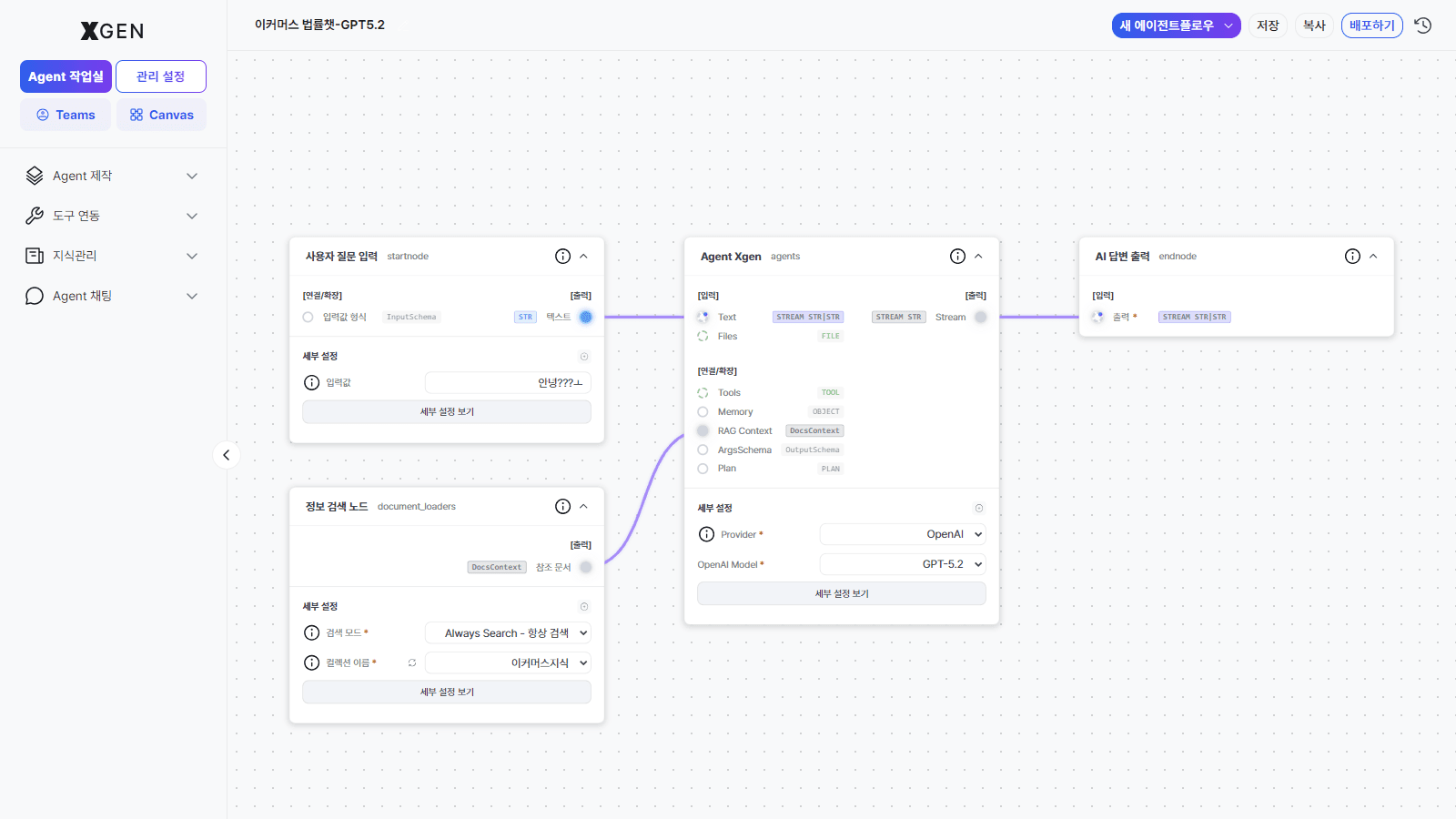
Agentflow design
Connect nodes by drag and drop on the canvas to design an AI workflow visually. Combine LLM calls, tool execution, and branching without code.
- Visual node-based editing
- Multi-agent collaboration
- Version control and execution logs
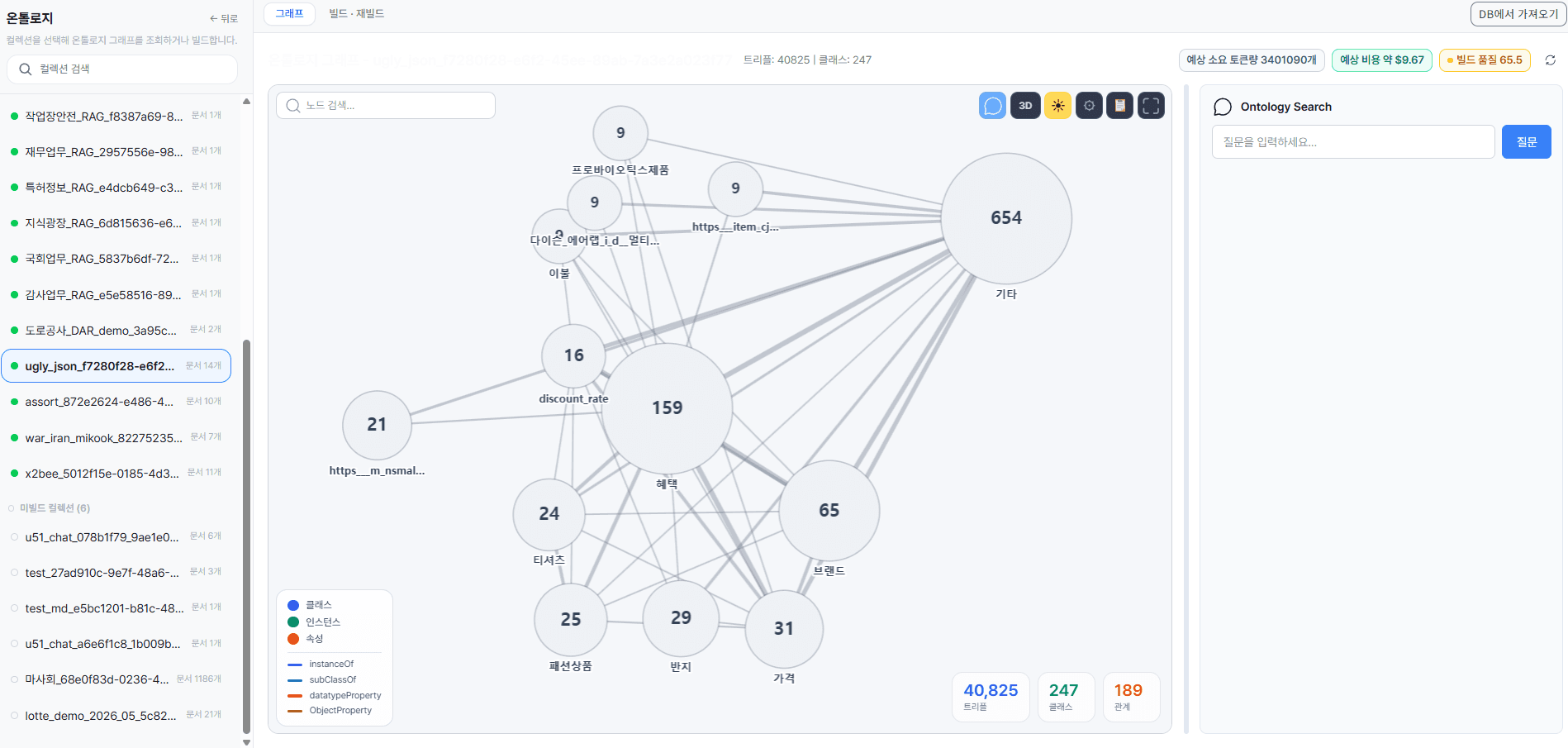
Knowledge and retrieval
Upload documents into a collection and chunking and embedding make them vector-searchable. Rerankers and ontology raise accuracy, and responses carry their citations.
- Collections, file storage, DB integration
- Vector DB, reranker, ontology
- Citation-backed responses
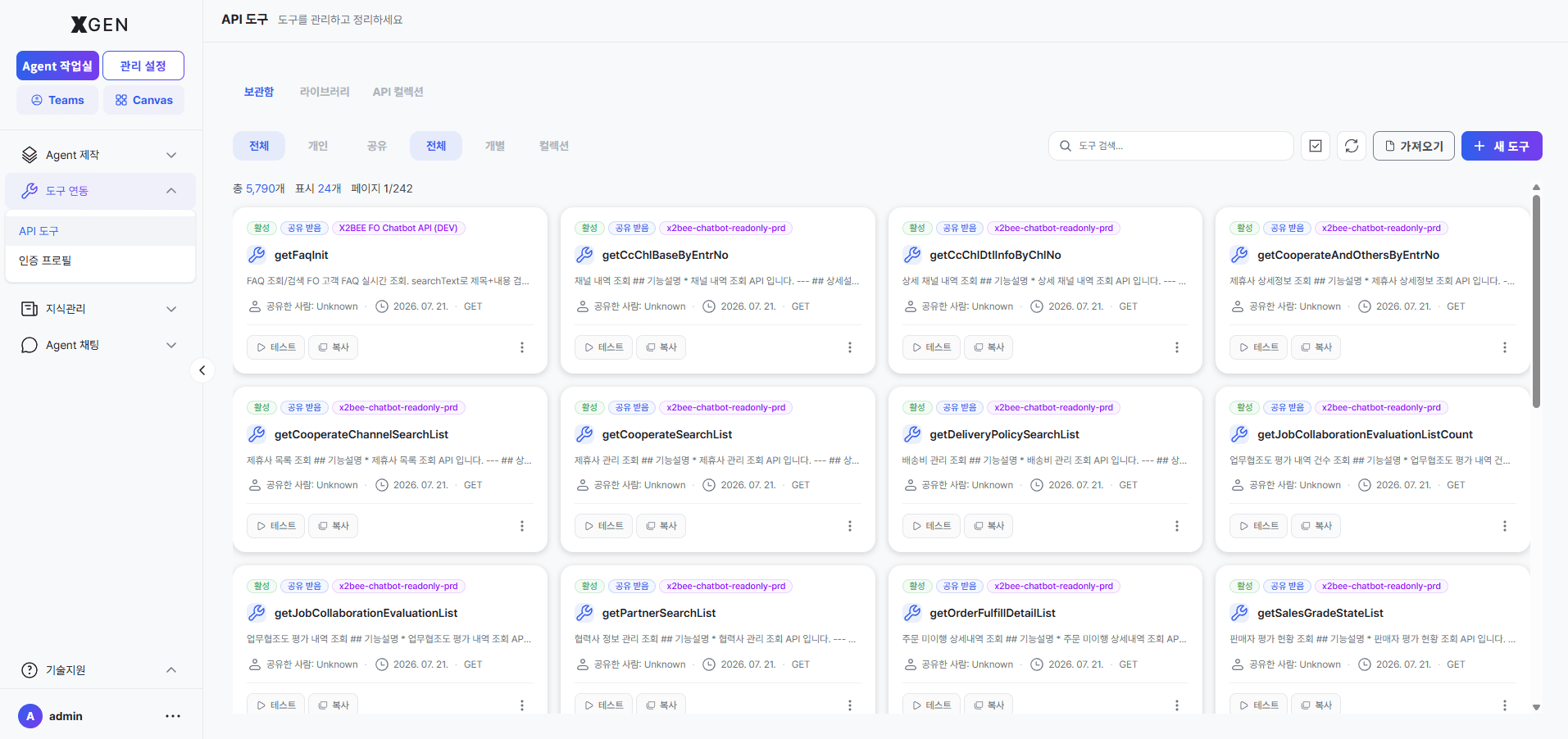
Tool integration and extension
Register external APIs and functions as tools an agent can call, and connect models to external tools through the MCP standard. Credential profiles keep keys and tokens managed safely.
- API tool registration and calling
- MCP standard integration
- Centralized credential profiles
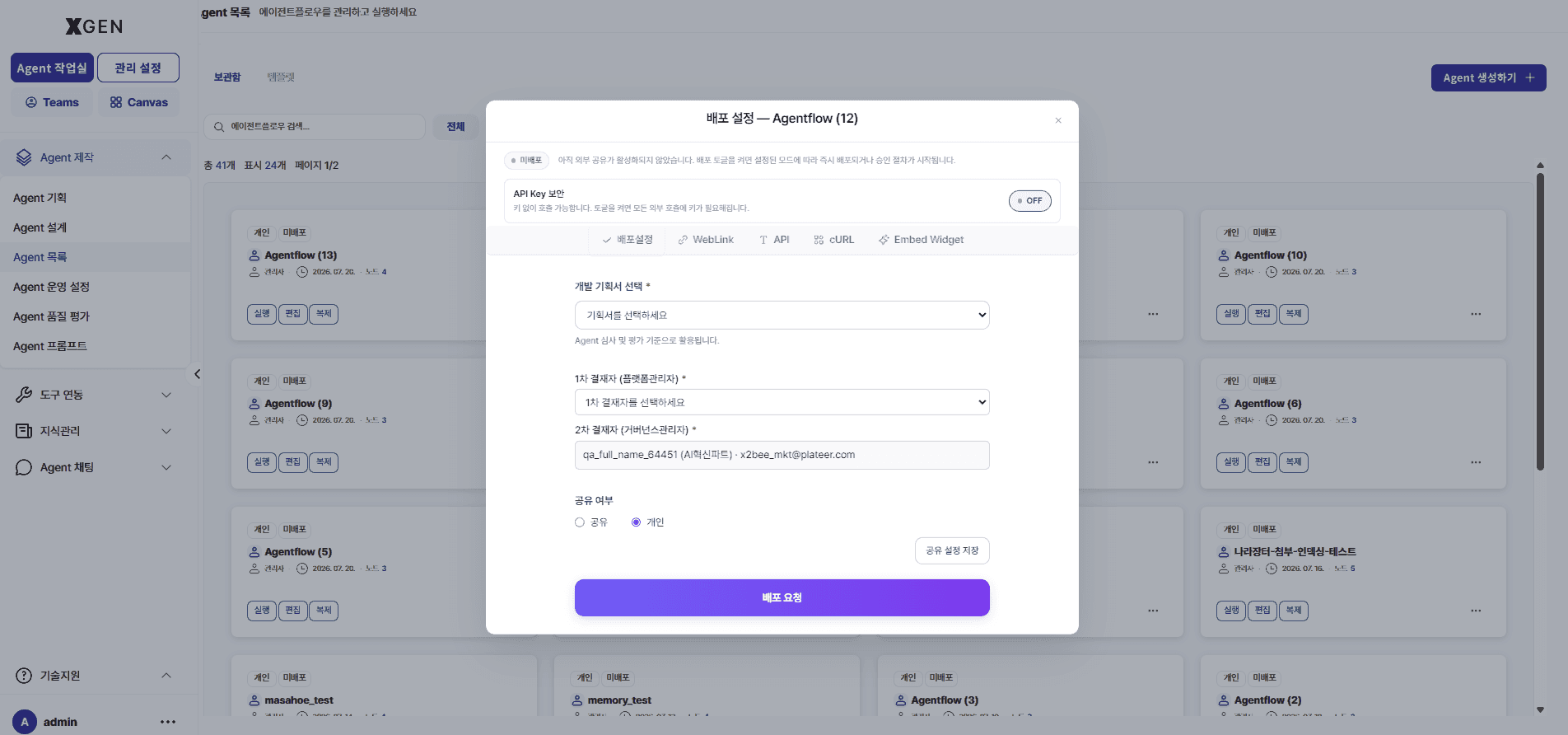
Deployment and operation
Deploy the agentflow you designed so users and external systems can call it. Embed it into an external site with a snippet, or run it on a schedule.
- Deploy, embed, share
- Scheduled execution (cron)
- Version and deployment state
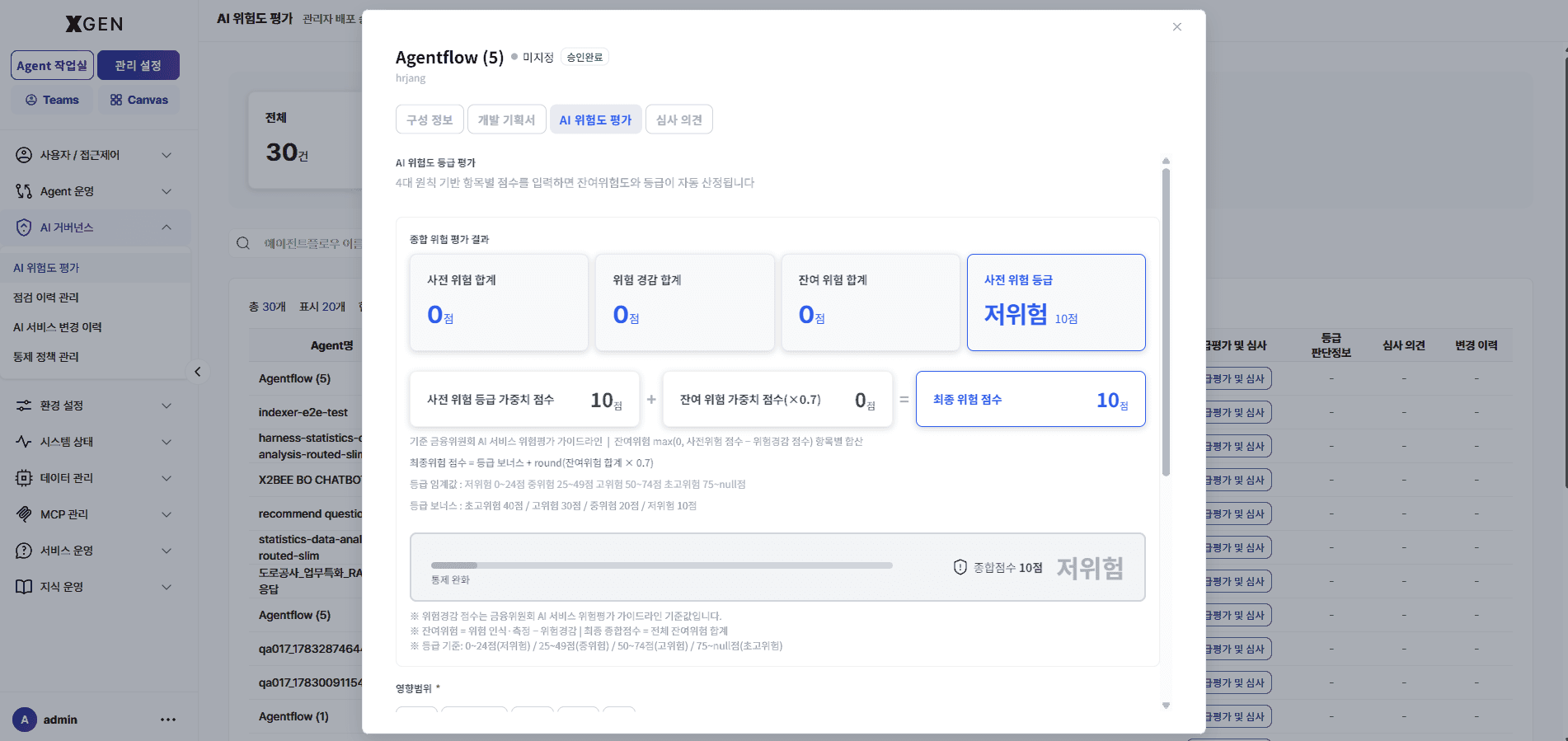
AI governance
Manage AI usage through PII masking, risk grading, and control policy. Dual deployment and governance approval, scheduled reviews, and audit logs meet the control requirements.
- PII masking and risk grading
- Dual approval and scheduled review
- Change history and audit logs
Dashboard and monitoring
Role-based widgets put status and statistics on one screen. Execution history, token usage, and system health, seen from an administrator's perspective.
- Role-based widget dashboard
- Execution history and token usage
- System health monitoring
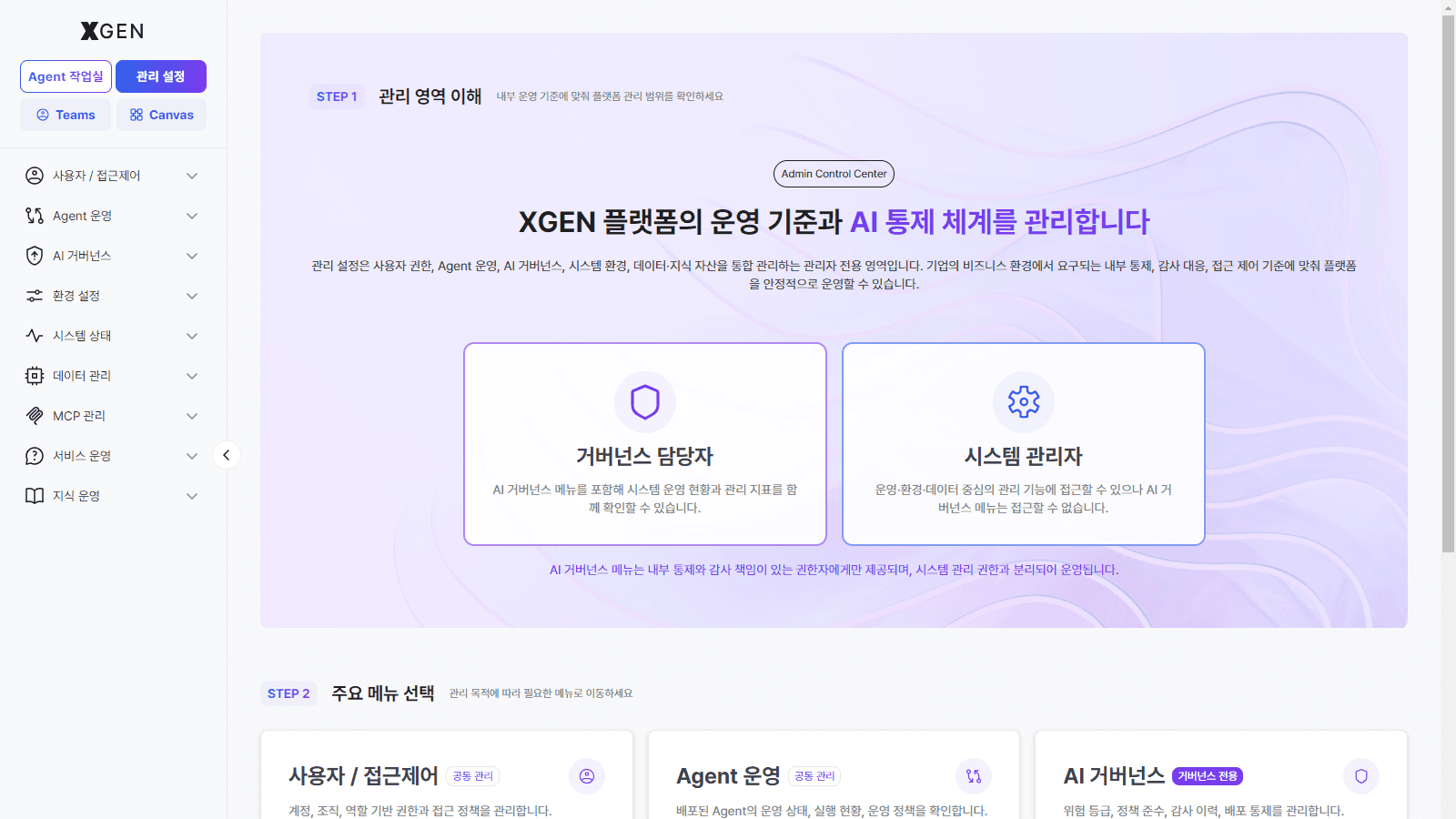
More product screens
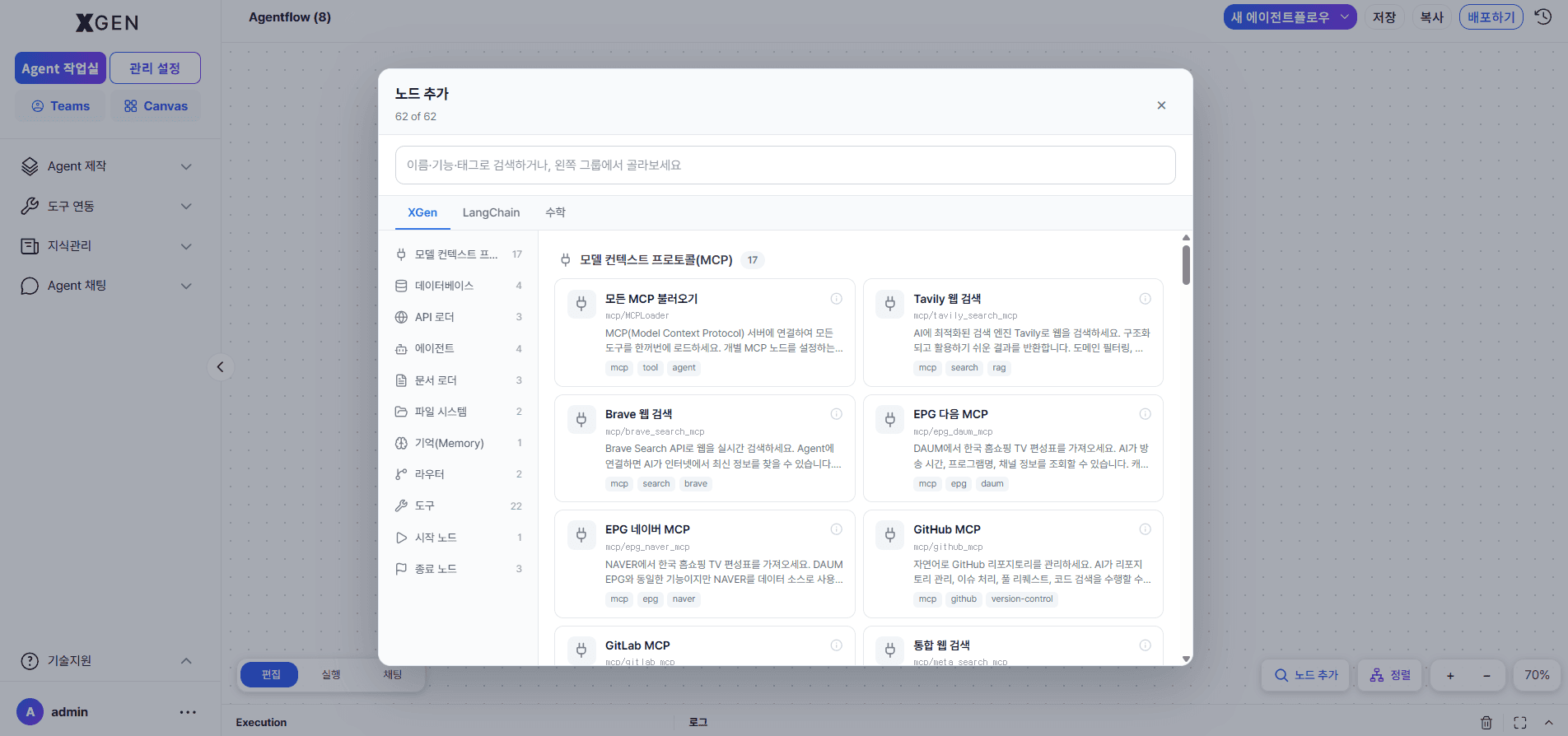
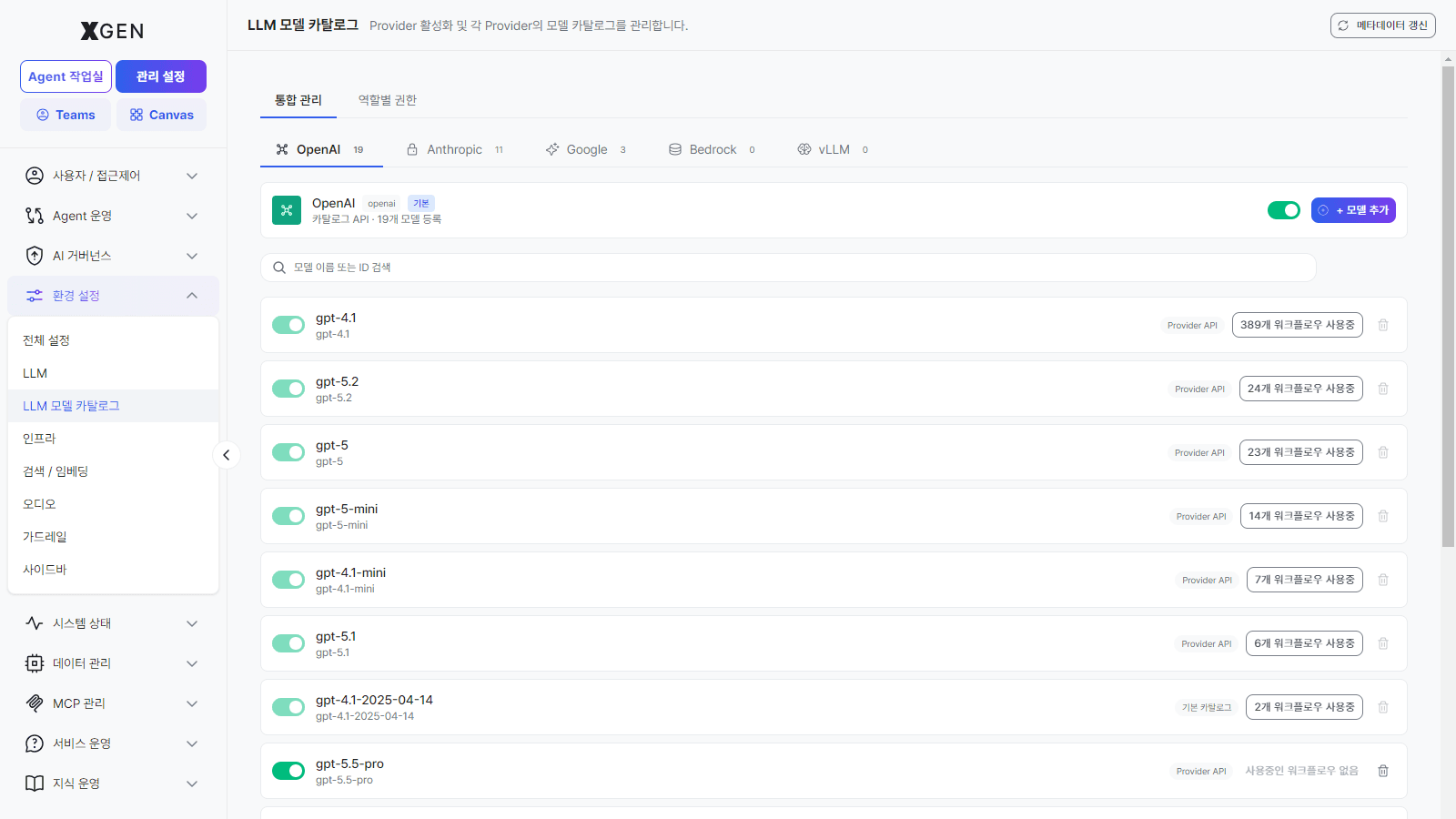
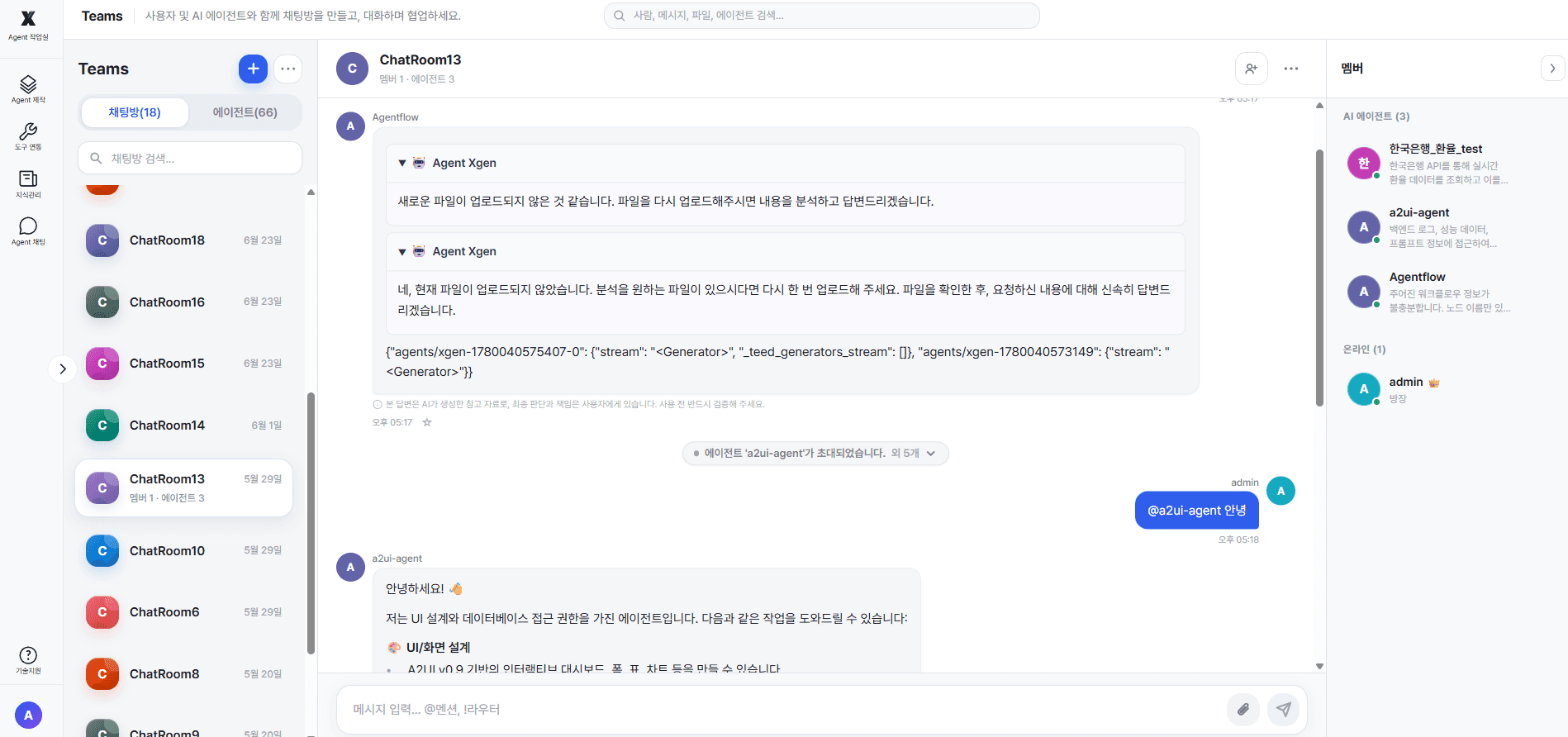
Core Technology · 6 Layers
A six-layer core architecture for Enterprise AI
From infrastructure up to AI agents, the core technology enterprise AI operation needs, integrated into one platform.
XGEN is not bound to a particular AI model or cloud. A standards-based six-layer architecture connects and operates on-premise GPUs, commercial AI APIs, and internal systems in a consistent way.
Roles
One platform, an experience shaped to the role
Even on one platform, the working environment is optimized by role and permission. Each user gets only the capabilities and information their work requires, and uses the AI more efficiently for it.
Standard User
Standard user
Gets work done with agents, supported by notices, FAQ, and one-to-one inquiries.
Agent Developer
Agent developer
Designs agents on the canvas, connects tools and knowledge, and requests deployment.
System Admin
System administrator
Operates users, permissions, LLMs, and the system, and approves deployments.
Governance Officer
Governance officer
Manages control policy and risk, and owns the final approval and audit before a service goes live.
On-Premise
Data stays inside the company, and gets used with confidence
XGEN is built on-premise so data never leaves, and technical safeguards prevent customer data from being used to train external models.
Leakage blocked at the source
An on-premise build means data is used safely without leaving your environment.
Network separation and air-gap
Deploys and runs in network-separated and air-gapped environments, meeting the closed-network requirements of finance and the public sector.
Zero training guaranteed
Technical safeguards prevent customer data from being used as training data for external models.
Deployment
From intake to operation, a proven build process
From closed-network intake through proof, build, and operation, support is staged around the on-premise environment. Once intake completes, proof starts quickly, supporting pre-production validation and early results.
Intake
Installed into your infrastructure (on-premise or air-gapped) through the closed-network intake process.
Proof of concept
Validated quickly against real data, settling the domain requirements and review rules.
Build
Domain tools, knowledge, and agents configured and integrated around the organization's work.
Operate
Controlled deployment, monitoring, and improvement continue through the GitOps pipeline.
We stay with you after the rollout
It doesn't end at the build. Training that lands the capability inside your team, and technical support that keeps it running steadily.
Enterprise Trust
AI you cannot trust
cannot run in an enterprise
XGEN traces who did what and when, verifies risky changes before deployment, and is designed so that only approved agents reach production. It provides governance you can rely on in regulated industries and on-premise environments.
Explore the security and governance architectureThree-layer permissions
Tier (Standard/SuperUser), role, and permission (ABAC keys) as independent layers, gating access down to individual screens and buttons.
Dual-approval deployment
Turning something into a service requires passing two stages: deployment approval from a system administrator and approval from a governance officer.
PII masking and risk grading
Personally identifiable information is masked automatically, and the risk level of requests and responses is classified and controlled.
Audit logs and scheduled review
User activity and system events are retained, and deployed agents are reviewed on a schedule.
Unauthorized access prevention
MFA (OTP), IP allowlisting, and session timeouts are applied together, so only permitted users get through.
Security built in from development
OWASP ZAP is embedded in the development and CI/CD pipeline to check vulnerabilities automatically before release — shift-left security.
Certifications & Quality
National quality and reliability certification
XGEN has been awarded Grade 1 GS certification and is undergoing AI-MASTER, the AI reliability certification. Accredited third-party laboratories verify the product's quality and reliability.
XGEN · GS certification, Grade 1
Good Software Certification · highest grade
XGEN has been awarded Grade 1 in GS (Good Software), Korea's national software quality certification. TTA, an accredited third-party laboratory, tested functionality, reliability, usability, and overall quality, and verified it at the highest grade.
AI-MASTER
AI reliability certification · Korea AI Industry Association (AIIA)
XGEN is undergoing AI-MASTER, an AI reliability certification in which a third party verifies the reliability, transparency, and robustness of the AI.
- AI reliability assessed against international standards (EU Trustworthy AI, ISO/IEC)
- AI governance documentation review alongside functional testing (63 quantitative criteria)
- Started June 2026 · roughly a 13-week assessment when it runs to plan
AI Quality Policy
Beyond certification — we publish the standards for trustworthy enterprise AI, defining everything from safety, accountability, and controllability to where our responsibility ends and yours begins.
Reviewing security, regulatory, or procurement requirements? We will work through the architecture and controls against your requirements with you.
Discuss security requirementsCustomer Cases
Proven in customer environments
Customer cases where XGEN was actually built and operated in finance, commerce, public sector, and IT.
Jeju Bank's internal generative-AI platform
Building an internal generative-AI platform on XGEN with Jeju Bank, then stabilizing it through on-site operations and widening its use across the bank
Jeju Bank
Generative AI for retention and review work
A commerce engagement with a large home-shopping retailer: generative AI for win-back retention and broadcast review, extended into a second year
A large home-shopping retailer
Large-scale procurement search, rebuilt on AI
A public-sector engagement rebuilding a mutual-aid association's procurement search on AI, then stabilizing it through on-site operations
A public mutual-aid association
FAQ
Frequently asked questions
What is XGEN?
XGEN is an on-premise Enterprise AI platform — an agent development environment for designing, deploying, operating, and governing Agentic AI services on the LLMs and infrastructure you choose. It is not a finished service delivered to you; you build and run the agents your organization's work needs on top of XGEN. It was designed and developed by the Plateer AI Labs AI research team.
Which LLMs and foundation models can we use?
You are not tied to a particular model. Choose among open-weight models such as Qwen and our own sLLM (Polar) by purpose, cost, and accuracy, and serve them on the GPUs and infrastructure you already own. The management center configures the LLM, vector DB, and the rest of the system in detail.
Does it handle non-text documents like images, tables, and charts?
Past simple text extraction (OCR), a VLM (vision-language model) reads the context of images, tables, charts, and graphs. OCR is one capability within the VLM; where needed, an open-weight VLM is served directly to turn charts and graphs into text, vectorize them, and use them in answers. This is already applied in commerce and finance settings.
Can a knowledge graph (ontology) be built from our messy data?
Yes. Even without tidy data, accumulating a few months of it and constructing an ontology links the different expressions of the same entity (for example US, USA, United States) into one. The richer the data the better the quality gets, and domain terminology mapping and review-rule design happen alongside. We have introduced knowledge graphs in commerce and financial projects.
How do you secure the answer quality of RAG and the knowledge graph?
Quality is scored on RAGAS from preprocessing through answer verification and evaluated across several dimensions. Preprocessing strategy is also selected automatically by document type — an adaptive pipeline where the LLM judges the document type and adjusts whether OCR or VLM applies, along with chunking and overlap parameters.
How does it integrate with our legacy systems?
You don't need to build new screens. LLM and RAG integration is composed as nodes and provided as snippet code, so adding a single button to an existing system to call it is entirely workable. XGEN is plugin-structured throughout — around 80 built-in tools combined with quickly-built custom tools keep integration and customization effort to a minimum.
What happens when an agent produces a wrong result?
A first filter applies at creation through risk assessment and administrator approval, and if something goes wrong in operation an admin kill switch stops the service immediately. Where accuracy is decisive we apply human-in-the-loop, designing the AI to raise throughput through pre- and post-processing rather than replacing the work entirely, with a person confirming the result before the next step.
How is data security guaranteed?
It is built on-premise so data never leaves, and it supports network-separated and air-gapped environments. Role- and attribute-based access control (RBAC/ABAC) plus a zero-training guarantee technically prevent customer data from being used to train external models.
Can we build agents without coding?
Yes. Agentflow's drag-based visual canvas lets you design a workflow without code, validate it in live chat, and deploy it as an API or workflow.
Are the open-source licenses safe from a procurement and legal perspective?
The open source that makes up XGEN is MIT, Apache 2.0, and BSD family — no GPL-family components with source-disclosure obligations, so commercial and internal distribution carries no obligation to publish source. We check and provide the obligations attached to each license type (copyright notices, NOTICE files), and can prepare a component-by-component license inventory on request.
Get Started
See enterprise AI that goes straight into the work
An Agentic AI platform that satisfies your security, permission, and audit requirements. In a demo we walk you through the whole flow — design, deployment, and control.