Different users need different AI work environments
Developers, data analysts, and business professionals expect different things from AI.
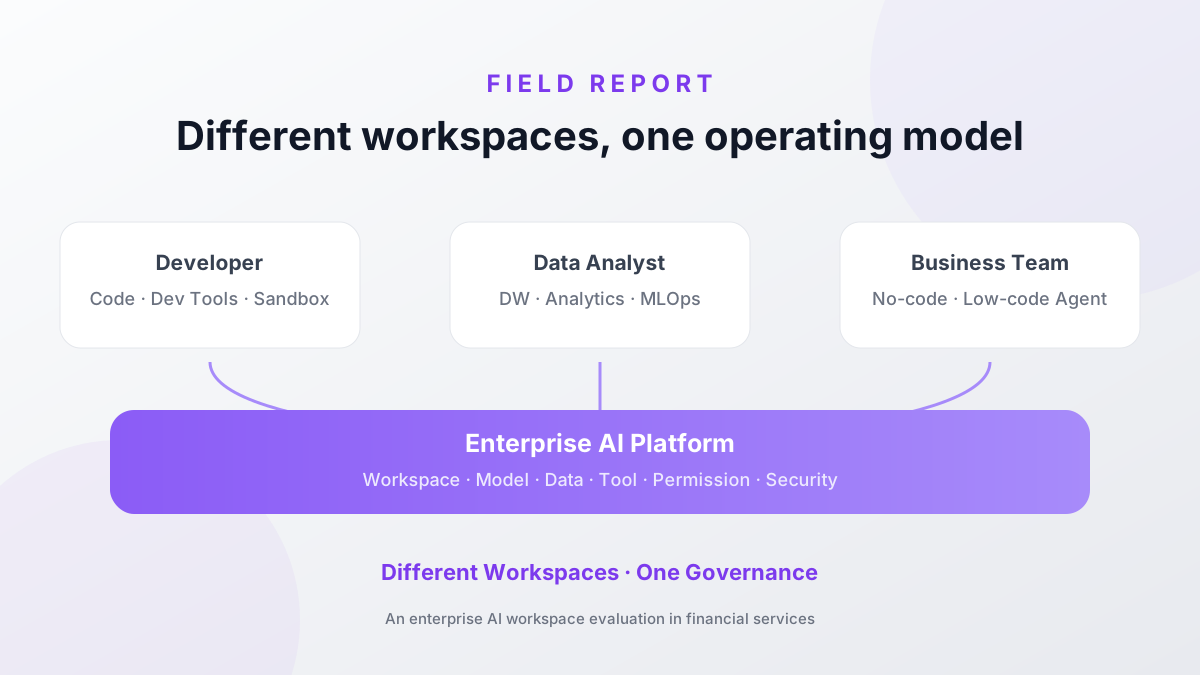
XGEN is designed to provide independent workspaces and execution environments for each user within one platform, allowing them to use the AI and tools their work requires.
Developers can work with code and development tools, analysts can access the data and analytical environments they need, and business users can configure agents without a complex development process.
The important point is not simply to place three sets of features on one screen.
The platform must support different ways of working while enabling the enterprise to manage models, data, permissions, and operating policies as one system.
Is vibe coding possible inside a closed network?
Financial institutions may not be able to use external commercial LLMs freely for development work.
XGEN supports operating open-source LLMs on premises and using them together with the organisation's internal development environment and library information.
The quality of vibe coding is not determined by model size alone.
The way internal development standards, library specifications, and code context are supplied also affects the result.
When AI-generated code is executed, sandbox- and container-based isolation can separate it from the host environment, while higher-risk tasks can be subject to additional controls.
Vibe coding in financial services is therefore a design problem that combines a capable model, internal development context, and a safe execution environment.
Large-scale data analysis is not solved by LLM context alone
Data analysis brings another question.
If the data is too large, doesn't it exceed what an LLM can process?
XGEN does not approach this by placing the entire dataset in the LLM's context.
Analytical workloads can use separate CPU and memory resources or connect to an existing analytics environment, while the LLM decides what work is needed and initiates its execution.
Existing data warehouses, analytics servers, and MLOps environments can also connect to XGEN through APIs or tools.
In other words, AI does not hold all the data itself. It performs work by using the existing data and analytics infrastructure.
Can AI connect without replacing existing systems?
This is one of the areas that requires the most work in a real enterprise AI implementation.
Enterprises already operate a broad range of IT assets, including CI/CD, DevOps, MLOps, data warehouses, ERP, and identity and access systems.
Rather than replacing all these environments with proprietary features, XGEN supports connections to them through APIs, tools, and gateways.
Connection alone, however, does not solve every problem.
If table and column information in a data warehouse is unclear, an LLM will also struggle to understand what the data means. In that case, schemas and business terminology need to be organised before they are connected to AI.
This is why building an AI platform ultimately becomes a question of how to make the existing IT environment understandable and usable by AI.
Field Report
The most striking observation from this discussion was how quickly the scope of an AI platform is expanding.
At first, the primary requirement was to help business users create agents easily. Once the organisation began considering enterprise-wide use, the question broadened to whether developer vibe coding, data analysis, and existing system integration could all be addressed on one platform.
But as the range of users grows, so does the range of things that must be managed.
Developers need development environments.
Analysts need data and analytical environments.
Business teams need an environment for building agents.
At the same time, the enterprise must manage models, data, tools, permissions, and security under one standard.
This is also the direction XGEN is pursuing.
The goal is not to add AI features one by one, but to create an enterprise AI work environment in which different roles use AI in their own ways while the organisation operates everything under one governance framework.
When evaluating an enterprise AI platform, the question now needs to go beyond “What AI features does it have?” to “Can the different people in our organisation work with AI on one platform?”