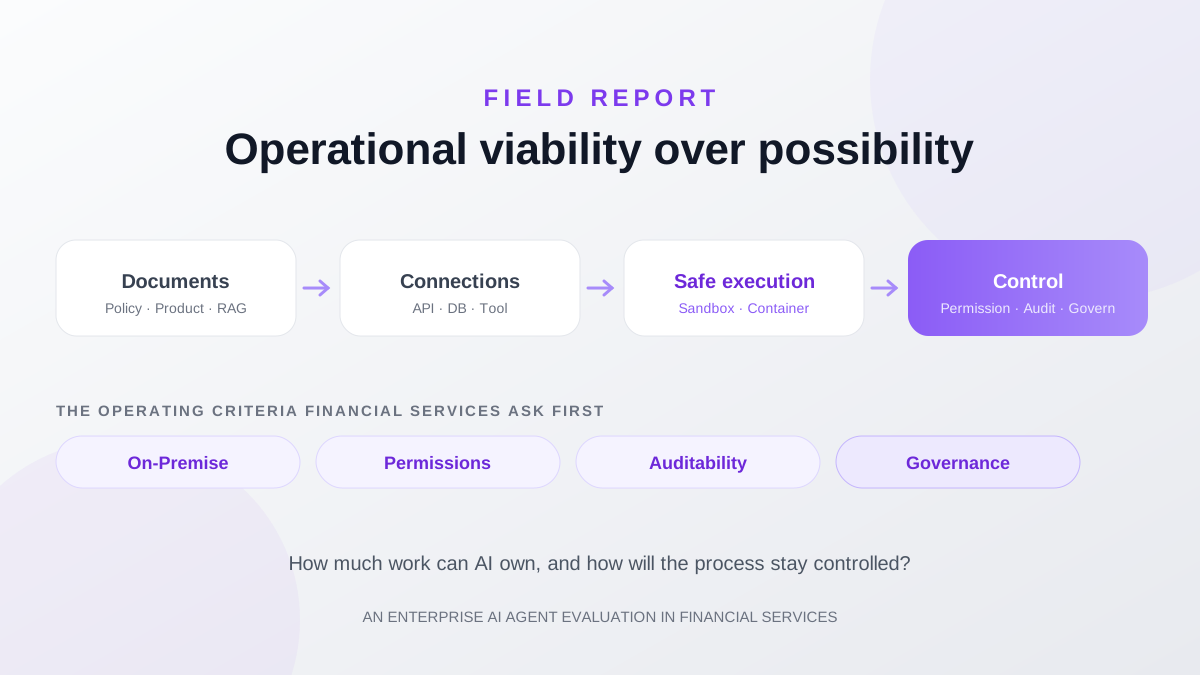
An enterprise AI agent evaluation in financial services and capital finance
Financial institutions ask about operations before AI agents: questions from the field
Financial institutions now ask whether AI can operate safely, not simply whether it works. Field insights on document quality, closed networks, auditability, business-built agents, and governance.
Financial institutions are beginning to ask less whether they can adopt AI and more whether AI can operate safely inside their existing environment.
In this discussion with a financial services and capital finance organisation, the questions came first to internal document accuracy, network isolation, integration with existing systems, the scope of business-led creation, permissions, and control — rather than the performance of a particular LLM. It was a sign that the competitiveness of AI agents is being decided by the operating model as a whole, not by one model.
The questions repeated in the meeting
Can they make proper use of our internal documents and data?
Can they operate inside a closed network?
Can business staff build agents themselves?
Can they connect to existing systems while remaining safely controlled?
Plateer AI Labs recently discussed the potential application of XGEN with an organisation in financial services and capital finance. Leaving aside the company's specific business plans, this report considers not only the functional answers but also why these questions came first and what they reveal about the changing criteria for enterprise AI adoption.
Q1. Can it make proper use of internal documents?
Financial institutions have a wealth of material that AI can use, including regulations, product documents, and operating manuals.
But if the structure and meaning of the source documents are not extracted correctly, the quality of answers from RAG and agents inevitably suffers.
XGEN is developing its own document parser to support a wide range of formats. It treats document processing as more than conversion to plain text: the important work is turning documents into knowledge that AI can use.
That is why the ability to read and structure an enterprise's documents properly matters as much as choosing a capable LLM.
Field Insight | Knowledge input now comes before model output
Document parsing was not treated as simple preprocessing in this discussion. If the structure of regulations and product materials is read incorrectly, the retrieval and agents built on top of them are difficult to trust. The question was becoming more specific: not merely “Can we use a good model?” but “Can it produce consistent answers grounded in our documents?”
Q2. Can business teams build agents themselves?
The people who understand the work best are ultimately the people who do it.
XGEN enables trained business staff, as well as developers, to configure the agents they need for their own work.
Roles can be divided so that business teams build straightforward workflows while specialists support complex system integrations. Existing APIs and databases can become agent tools, and even business application screens can be connected as tools an agent can use.
The point is not to hand software development to business users. It is to let them translate their operational knowledge into agents.
Field Insight | Business autonomy depends on clear role boundaries
Behind the question of whether business staff can build agents sits another: who is accountable for operating them? Business teams can configure straightforward work while specialists and governance processes own complex integration and deployment. Self-service in financial services is less about unrestricted freedom and more about implementing operational knowledge quickly within an approved scope.
Q3. Can an agent perform real work inside a closed network?
In financial services, where data moves and what AI can access matter as much as model performance.
XGEN supports on-premise deployment and the operation of internal LLMs, allowing internal data and systems to be connected in line with the organisation's security policies.
An agent may use APIs or databases to perform work, while tasks that require execution, such as Python code, can run in isolated sandbox- and container-based environments.
The security needed when AI only generates an answer is different from the security needed when it executes actions in a real system.
Field Insight | Attention is moving from model performance to the execution environment
In this meeting, where data travels, how far execution permissions extend, and what can be stopped when something goes wrong were treated as more important criteria than the range of models available. Once AI moves beyond answering questions and begins performing work, isolation, permissions, and control become product requirements on the same level as performance.
Q4. Can connections and controls scale with the number of agents?
One agent does not need to handle every task.
In XGEN, agents can be connected like nodes so that several agents divide roles and carry out a single workflow. MCP can also extend the range of tools and external systems they can connect to.
At the same time, central management becomes more important as business teams create more agents.
The organisation needs permissions and governance that determine who may use which models and data, which tools they may access, and which agents they may deploy.
In other words, the structure has to preserve both the autonomy of business teams and enterprise control.
Field Insight | Financial institutions look beyond agent count to auditability
Connecting multiple agents and tools is not enough to establish an operating model. The organisation must be able to determine who used which data and tools, under what authority, and through what process a result was produced. As the scope of automation grows, auditability becomes as important as accuracy in the adoption decision.
What this meeting confirmed
The meeting revealed three shifts.
Financial institutions examine the operating model before the LLM. Data location, execution environment, access permissions, and controls have become adoption conditions alongside model performance.
They look beyond one PoC to the structure for the next task. The question is not only whether one agent works, but whether its documents, tools, and workflows can be reused and managed across other work.
They ask about governance before agents. As business teams build agents and connect more systems, deployment authority, execution records, change management, and lines of accountability have to be designed first.
These are not separate requirements. They converge on one need: the entire sequence — understanding documents → connecting internal data and systems → performing work → collaborating with other agents — must remain inside a common framework for security, permissions, and governance.
XGEN is evolving to connect this process in one enterprise AI platform. The more important conclusion from the field, however, was not a list of product features. It was that the adoption test for AI agents in financial services is changing from “Is it possible?” to “Can we keep it operating under control?”
Questions to carry into the next project
Before choosing a model, a financial institution evaluating AI agents should ask:
Who is accountable for the quality of the documents and data the AI uses?
How are query and execution permissions divided across users, agents, and tools?
Can the execution path and the evidence behind a result be traced later?
Who reviews, deploys, and manages changes to agents built by business teams?
Can knowledge and tools from the first agent be reused in the next task?
The evaluation should begin not with “Which AI should we use?” but with “How much of our work can we entrust to AI, and how will we control the process?”
Subscribe to keep reading
Read the full field report
What we learned from customer meetings and PoCs. Leave the details below to open the rest — and we will let you know when a new field report lands.