
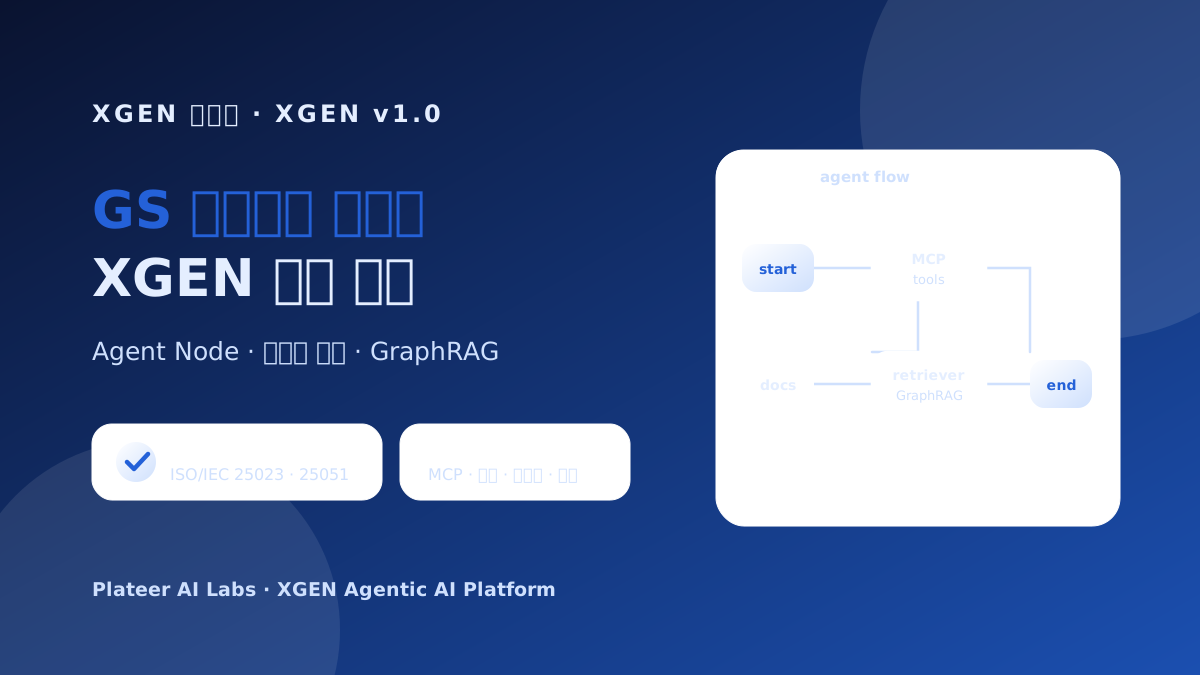
The XGEN Agentic AI Platform covers what an Enterprise AI platform has to cover — building AI agents, integrating with existing systems, GraphRAG-based knowledge management, and AI governance — and it passed quality testing against the international standards ISO/IEC 25023 and ISO/IEC 25051 in GS certification at TTA, Korea's accredited testing body.
An earlier post covered how the XGEN Agentic AI Platform reached Grade 1 GS certification, and how we worked through the improvements found during testing.
This time we want to tell a slightly different story.
GS certification is not a procedure where someone installs the product and looks at it. The Telecommunications Technology Association (TTA), an accredited testing body, verifies a product's functionality and quality directly, against the international standards ISO/IEC 25023 and ISO/IEC 25051.
So what did TTA actually check in XGEN?
This post walks through the core capabilities of the XGEN Agentic AI Platform, organized around what the testing verified.
A platform for designing and operating AI agents yourself
Enterprise AI is no longer a chatbot.
AI agents — which understand the work, connect to several systems, and automate what repeats — are settling in as a new way of working.
XGEN lets business users, not only developers, design and operate those agents themselves.
TTA's testing confirmed that 42 core agent nodes work as intended.
The main capabilities:
- Agent workflow design
- MCP and agent integration
- API and document-processing nodes
- Conditional branching and iteration
- Prompt template management
- Agent template management
- Testing and deployment
Agents used repeatedly can be saved as templates and reused across the organization, which is how AI services spread and become standardized.
Enterprise AI that connects to the systems already in place
For enterprise AI to carry out real work, it has to integrate with what is already running — ERP, groupware, databases.
XGEN provides the following so those systems can be connected and operated reliably:
- REST API registration and management
- JSON-based API definition
- API library management
- Database connection management
- Credential management
- Connection testing
Testing a connection before registering it means integration errors that would otherwise surface in operation get caught in advance.
A knowledge platform that turns enterprise documents into AI knowledge
The quality of a generative AI's answers depends on how accurately it draws on the knowledge inside the enterprise.
XGEN manages documents as knowledge collections and supports building RAG-based AI services on top of them.
Supported document formats:
- Word
- Excel
- PowerPoint
- TXT
- HWP / HWPX
Beyond uploading, chunk settings and change history are managed alongside, which improves traceability and makes the collections easier to operate.
Advanced knowledge search on GraphRAG
In enterprise work, keyword search alone is often not enough.
XGEN uses a knowledge graph and GraphRAG to analyze the relationships and meaning between documents.
Testing confirmed the following work as intended:
- Ontology build
- Knowledge graph generation
- GraphRAG question answering
- Graph browsing
- Inspecting how an answer was produced
Together they give more accurate knowledge search, in an environment where the basis for an answer can be checked.
Governance for operating Enterprise AI
For an AI platform, operating it matters more than building it.
XGEN ships the operations and administration capabilities an enterprise environment needs:
- User and permission management
- Menu access control
- LLM management
- Embedding model management
- Reranker management
- Vector database management
- Agent pre-validation
- System log management
- Server resource monitoring
- User feedback management
Models are managed independently, so commercial LLMs and on-premise sLLMs can both be applied flexibly.
Software quality, verified in GS certification
TTA tested XGEN against the international standards across nine quality characteristics:
- Functional suitability
- Performance efficiency
- Compatibility
- Usability
- Reliability
- Security
- Maintainability
- Portability
- General requirements
Every improvement identified during testing went through a fix and a regression test, and the final state was confirmed at zero defects.
That means XGEN meets the software quality bar an enterprise environment demands.
Note: the security evaluation in GS certification is a software-quality test. It does not replace an information-security certification or a source-code security assessment.
A verified platform for Enterprise AI
When generative AI is applied to enterprise work, picking the newest model is not the whole job.
What is needed is a platform that operates AI safely, connects it to the systems already in place, and keeps it usable across the whole organization.
This GS certification means XGEN has been objectively verified — in both function and quality — as that kind of Enterprise AI platform.
Even now, Plateer AI Labs keeps advancing what building and operating Enterprise AI requires: more than 80 agent nodes, system integration, knowledge management, and AI governance