
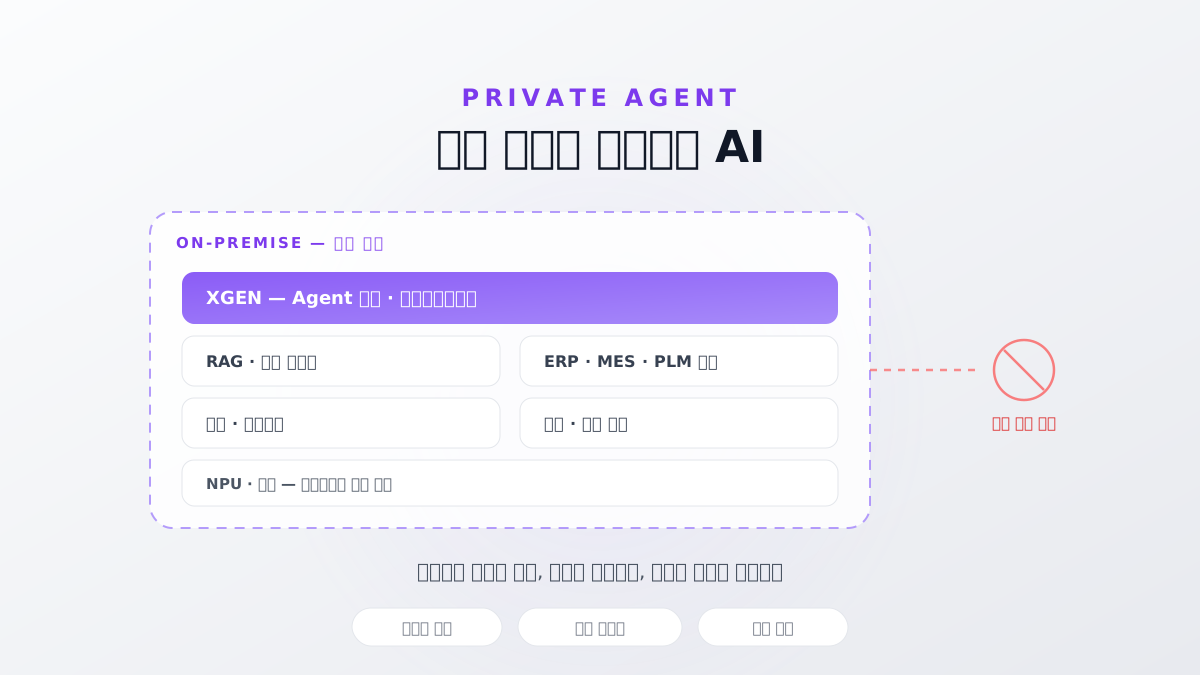
As enterprise AI evolves from a tool that generates answers into agents that carry out real work, the criteria for choosing an AI platform change with it. Model performance is no longer the only thing that matters. The platform has to protect data inside the enterprise security boundary, connect safely to existing systems, and keep the AI's decisions and actions controlled and traceable.
The XGEN Agentic AI Platform is an on-premise agent platform designed for exactly this kind of enterprise AI environment.
AI is moving from 'answering' to 'executing'
Enterprise use of generative AI started with individual productivity — drafting documents, searching for information, summarizing, translating, and assisting with code.
The role of AI agents is now going a step further.
They connect to internal systems such as ERP, MES, PLM, groupware, and databases to retrieve the information they need, make judgments about the work, and execute tools and processes within the permissions they have been given.
As AI moves beyond an assistive tool and becomes an actor with access to enterprise systems and data, the criteria an enterprise has to review change as well.
- Does core data stay inside the enterprise security boundary?
- Can the data and systems an agent may reach be controlled?
- Can you trace who executed what, through which agent?
- Are core operations insulated from outages or policy changes at an external AI service?
- Can AI be applied while existing systems and security policies stay as they are?
In industries where data sovereignty, security, and regulatory requirements weigh heavily — manufacturing, finance, the public sector, defense, semiconductors, energy, healthcare — these conditions are becoming the deciding factor in whether AI gets adopted at all.
The challenge of on-premise AI is not 'installation' but 'operation'
Installing an LLM in an on-premise environment does not, by itself, make enterprise AI complete.
Applying AI agents to real work requires more than a model and infrastructure: several technologies and operating structures have to interlock.
Infrastructure → Model → Data → Agent → Enterprise System → Security → Governance → Operation
You need GPU and inference infrastructure suited to the enterprise environment, and the model has to run reliably on it. Internal documents and data have to be connected to RAG and a knowledge structure, and agents have to be wired into existing systems such as ERP, MES, and groupware.
On top of that, per-user and per-agent access rights, execution controls, logging and audit trails, AI risk management, and governance all have to be designed together.
Implementing any one of these in isolation makes it hard to move past a proof of concept and into a real operational system.
In the end, the competitiveness of on-premise AI comes down to not whether you can install an LLM internally, but whether you have the structure to keep operating AI inside the enterprise.
XGEN connects the whole of enterprise AI operation into one platform
XGEN is not an interface for using a particular LLM. It is an agentic AI platform for building, connecting, controlling, and operating AI agents inside the enterprise.
1. Execution inside the enterprise security boundary
XGEN supports on-premise environments, so enterprise data and the AI execution environment can be configured to match internal security policy.
It is designed so that core enterprise data — sensitive documents, design information, process data, source code, customer records — can be used inside the internal environment without being handed to an external AI service.
That lets an enterprise apply generative AI and agents to its work while keeping its existing data security policy and infrastructure strategy intact.
2. Agents that connect to existing business systems
The value of enterprise AI is not decided by answer accuracy alone.
An agent has to be able to retrieve the data the work actually needs and safely execute the systems and tools involved.
XGEN connects not only internal documents and knowledge data but also APIs, databases, and existing business systems as agent tools, so AI operates inside real business processes.
Enterprises can apply AI agents to their current environment step by step, without replacing the systems they already run.
3. Control over agent permissions and execution
Once AI agents start executing against enterprise systems, controllability matters more than convenience.
XGEN provides the controls enterprise AI operation requires at the platform level — permission management per agent and per user, execution history, and audit logs.
This lets an enterprise go beyond "what did the AI answer" to managing and tracing
who → used which agent → accessed which data → and executed which tools
4. Connecting the server to the user's working environment
Real enterprise work does not happen only on servers.
Writing documents, managing files, using in-house applications — much of the work starts on the user's PC.
Deks (Device Experience) is the execution layer that connects centrally managed XGEN agents to the user's desktop working environment.
The aim is a structure where the enterprise manages AI and agents centrally while users take advantage of AI without significantly changing how they already work.
5. The AI governance an enterprise environment needs
The more AI participates in real business processes, the more operating standards and accountability matter alongside model performance.
XGEN builds the governance an enterprise needs for continuous AI operation into the platform — permission management, execution history, and AI control policy.
Plateer AI Labs applies these standards not only to product features but also codifies them as an AI quality policy and operating procedures that we manage on an ongoing basis.
6. Verified quality and field-led implementation
Enterprise AI adoption does not end when the features are built.
It has to be verified as stable in a real enterprise environment, then applied to the actual work and embedded until people keep using it.
XGEN Agentic AI Platform holds GS Certification Grade 1, and we continue to verify the platform's quality and reliability against objective standards.
Our field-led technical support structure also supports the real adoption process — from requirements analysis through agent design, system integration, verification, and internalization of operations.
What an enterprise should choose is not a 'model' but an 'operable AI environment'
The competitiveness of enterprise AI will not be decided by which LLM you picked.
Models will keep improving, and they can be replaced.
Enterprise data, systems, security policy, permission structures, and business processes, on the other hand, have to persist.
So the core of an enterprise AI platform is not being tied to a specific model, but
whether infrastructure, model, data, agent, security, and governance can be connected into one operating layer and managed continuously
That is exactly what XGEN aims at.
An environment where core enterprise data stays under enterprise control, agents connect while existing systems and working environments stay in place, agent access and execution are controlled, and new models and technologies can keep being adopted.
XGEN goes beyond a platform for introducing AI: it provides the enterprise AI foundation for operating AI agents in real work, continuously.
If security, regulation, or data sovereignty make it hard to scale core operations on public AI services alone, XGEN is a way to review a private agent architecture and adoption plan suited to your environment.